

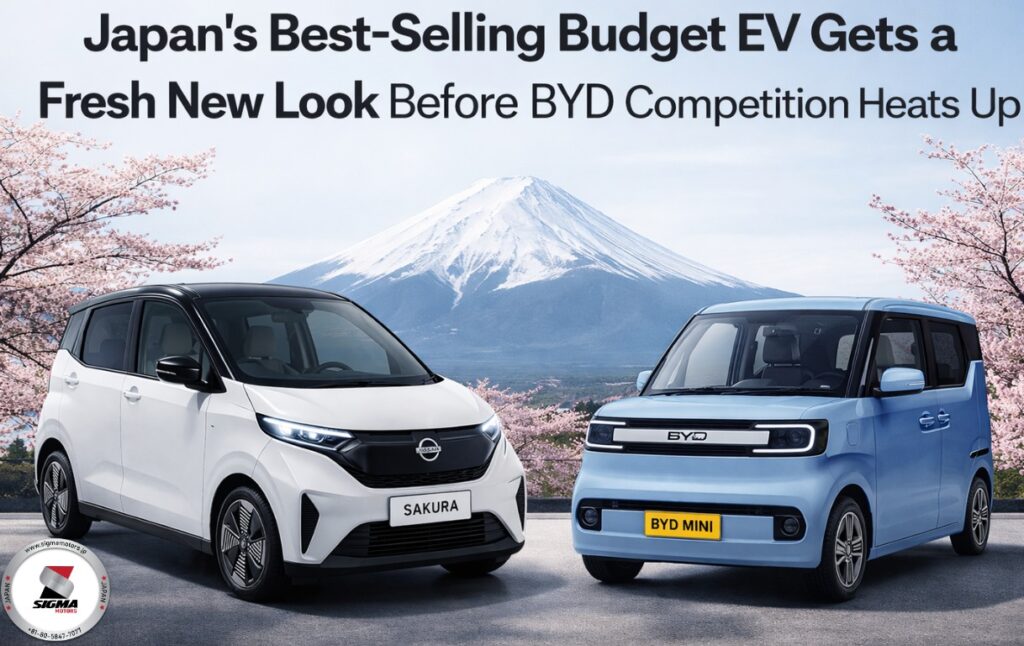
Japan’s affordable electric car segment is heating up fast, and the Nissan Sakura is making sure it stays ahead. The popular Kei EV has received a subtle facelift for 2026, just as new rivals—especially from China—prepare to enter the market.
Known for its low price, compact design, and smart features, the Sakura continues to dominate as one of Japan’s favorite electric cars.
A Market Leader Under Pressure
The Nissan Sakura has been a massive success:
- Japan’s best-selling EV for four consecutive years
- Over 14,000 units sold in 2025 alone
- Designed specifically for urban driving
However, increasing competition—especially from brands like BYD—is forcing Nissan to keep the model fresh and competitive.
2026 Facelift – What’s New?
The 2026 update focuses on refinement rather than major changes, keeping the winning formula intact.
🔹 Exterior Updates
Minor styling tweaks for a fresher look
New color options inspired by Japanese aesthetics
Slight design inspiration from newer Nissan EV models
🔹 Interior Improvements
Improved cabin usability (e.g., repositioned USB ports)
Additional convenience features like extra storage
Retains digital cluster and infotainment system
Overall, the facelift is about enhancing user experience rather than redesigning the car.
Same Trusted Electric Performance
Nissan has kept the core EV setup unchanged—because it already works well.
Key Specs:
- 20 kWh battery pack
- Approx. 180 km range (WLTC)
- 63 hp electric motor
- Smooth, quiet driving experience
This setup is ideal for daily city commuting and short-distance travel.
Why It’s Called Japan’s $11,800 EV
One of the biggest reasons behind Sakura’s success is its pricing.
Starting price around ¥2.44 million (~$15,400)
With government EV subsidies, effective price drops to about $11,800
This makes it one of the most affordable electric cars in Japan.
Rising Competition from BYD
The biggest challenge now comes from Chinese automaker BYD, which is preparing to enter Japan’s Kei EV segment.
Upcoming models like BYD’s compact EVs are targeting similar pricing
Positioned directly against Sakura in the budget EV category
This signals a new price and technology war in Japan’s small EV market.
Why Sakura Still Stands Strong
Despite growing competition, the Nissan Sakura maintains strong advantages:
✔ Proven reliability (Japanese engineering)
✔ Affordable pricing
✔ Practical range for daily use
✔ Compact size perfect for city driving
✔ Strong brand trust in Japan
Impact on Global & Asian Markets
This competition is not limited to Japan—it will impact Asia as well:
More affordable EVs entering the market
Faster innovation in small electric cars
Increased pressure on pricing
Countries like Pakistan could benefit from cheaper and better EV imports in the future.
Final Thoughts
The facelifted Nissan Sakura proves that staying on top requires constant evolution—even for a best-selling EV.
While the updates may seem minor, they are strategically important as:
- Competition from BYD intensifies
- Demand for affordable EVs rises globally
The Sakura remains a benchmark for budget electric cars, combining affordability, practicality, and trusted Japanese quality.
Sigma Motors Japan – Your Trusted Gateway to Japanese Car Imports
We bring you the latest Japanese EVs and vehicles directly from auctions, ensuring quality, transparency, and the best value for your investment.